THE PADCO SWIFTLET ECO PARK
Circa 2010-2013
The below content was created from circa 2010-13 archived pages of this site which was created to promote the latest project of P.A.D.Co Holdings Sdn Bhd:the establishment of an Eco Park development for the farming of Swiflets nests for the ever expanding Chinese market for Bird's Nest products not only in China, but also world wide. According to traditional Chinese medicine practitioners, the soup provides a boost to the immune system, smoothes the skin and acts as an aphrodisiac, which may be why the dish can sell for thousands of dollars. Because the Swiflets bird's nests are a multi-billion dollar business in Asia, some countries like Malaysia are promoting eco farms where people can create Swiflets farms to produce the nests rather than depending on poaching the birds' nests from natural caves. Such poaching has decimated many Swiflets populations in a number of areas in China, Thailand, and Malaysia. I wrote a final's paper on SWIFTLETS AND BIRD'S NEST SOUP for an ecology course I took in college. I was into action Batman hoodies & T shirts from MoonAtMidnight at the time. I always was attired in at least one item of clothing that related to Batman and always had a Batman DC comic in my backpack. Friends used to call me The Bat. The years have passed but not my obsession with Batman or with the protection and study of Swifts. Just recently I read an article in the NYTimes about how the growing demand for bird’s nest soup has spelled trouble for the birds. It has gotten to the point where Swiftlet populations have fallen steeply in some regions, prompting conservation officials to look for ways to protect the species. Such commercial enterprises such as what P.A.D.Co Holdings Sdn Bhd was promoting in 2010 still exist and problems with poaching, endangered birds, and counterfeit bird nests persist.
WELCOME TO P.A.D.CO HOLDINGS SDN BHD
A Dragon Company
The White Dragon emblem of Wessex, England is the logo & flag of P.A.D.Co Holdings Sdn Bhd (821040-X) , an Anglo Iban Bumiputra Company based in Bintulu, Sarawak, Malaysia.
The Dragon symbol is believed to have originated in China and was brought to the original Saxon tribes from Rome. When the Saxons migrated into Britain they brought the White Dragon emblem with them.
A brief history of the Saxon White Dragon for those interested in ancient history, folklore and legends. See here for a Wikipedia page about the ancient Kingdom of Wessex.
Let us help you make this 2013, The Year of the Snake, Your Year to commence on a future of Prosperity. As the logo for Padco is a Dragon, which is only a large Snake, we are expecting 2013 to be a very successful year for the company.
P.A.D.Co Holdings Sdn Bhd (821040-X) is a company registered in Bintulu, Sarawak, Malaysia. The Companies current activities are mainly in Oil Palm Plantations but also include a Jatropha Curcas Plantation, Pig Farm, Orange Grove and Fish Ponds. The latest project is to establish an Eco Park development for the farming of Swiflets nests for the ever expanding Chinese desire for Bird's Nest products in China and Globally. We are also building fully fitted, detached stand alone units in the area for local owner operators. In May 2010 we started to operated a stockist for DXN health & wellness products in Bintulu. We are also in the process of starting a State wide free monthly advertising magazine and flyer distribution service.

+++
WELCOME TO PADCO SWIFTLET ECO PARK – BINTULU
We are now developing stand alone swiftlet houses on titled agricultural land.
Padco Eco Park will be built in an area that is secluded, close to the sea, rivers and ponds. The locality is in close proximity to Oil Palm Plantations, Padi growing areas and is surrounded by natural forest. The Eco Park is also a short bird's flight from the Urban Centre of Bintulu, with it's existing number of thriving birdhouses.
Overseas Investors will have easy access through Bintulu Airport's daily flights to Kuala Lumpur, Kuching, Kota Kinabalu and beyond
2010
2010 will see the launching of our Eco Park, specifically designed for the rearing of swiflets that produce edible nests, in a rural environment.
New developments will be posted on this page, but to be the first to hear the news why not subscribe to our mailing list? Fill out the form below, Today.
For China Investors we will be exhibiting our concept and making presentations at the 1st International Bird's Nest Expo 2010 to be held in Guanzhou, China between 2nd & 5th September 2010. Download Brochure Here.
We are now developing stand alone swiftlet houses on titled agricultural land.
- These units will be fully licensed and with a registered enterprise company.
- All units will be designed and fitted out by experienced consultants who have above average success rates.
- All units will be built on leased 1/2 acre plots of agricultural land.
- Unit sized at 25' x 75' over 3 floors, total of 5625 sq ft.
- Build size and fittings options packages will be available.
- Developed specifically for local owner operators.
- Security packages available.
- Investment Packages from around RM 399,000 upwards
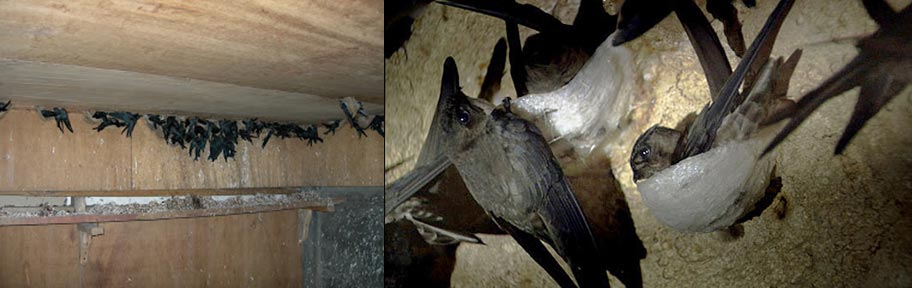
Make Millions from Swiftlet Farming
There is a saying, “If you do Swiftlet farming for 3 years, you will be taken care of for the rest of your life”. Whilst this sounds exaggerated, in reality it sums up how lucrative the returns can be.
Nan Yang Shang Pau reported in detail on 28th September 2007 that a successful 20 by 70 feet swiftlet house can bring millions of reward in 3 years after starting full harvest!
Let’s make a simple calculation as follows:
A standard two story 20 X 70 feet shop house will have a build up area of 2800-square feet. This means that such a shop house can produce 2800 edible birdnest in every 4-month, thus annual production of 8400 edible birdnest. (On average, swiftlets have three broods per year and usually lay two eggs per brood).
Base on 110 edible birdnest per 1 kilogram (about 9 gram per edible birdnest), and assuming the selling price of Ringgit Malaysia (RM) 4,5000 per kilogram, thus 8400 edible birdnest equals to 76 kilograms, and the value of RM 342,000 is the return of investment generated annually at full production. By projection, within 3 years of full harvest, the value of RM 1 million is attainable.
There is legislation in Sarawak to ensure that swiftlets houses can be built and operated on agricultural land, but not residential houses or shop lots, due to the Sarawak Land code section 33 cap 81.

Disclosure: The owner of this site may be compensated in the event you make any purchases based on their recommendations.
Typical Ad for Swiftlet House
Land / Swiftlet Farm FOR SALE:
Ad Number: 46979
Date Posted: 04/09/2010
Swiftlet ranch house for sale on coastal estuary agricultural land near Bintulu.
Newly built 25 x 75 ft of 3 floors = 5625 sq ft on 1/2 acre plot. Land at RM5200/year rental.
Designed by experienced & successful consultants
Sarawak Swiftlets farming license and Malaysian Enterprise Company included
Complete sound systems, temperature/humidity controls, full security and solar power packages available for installation upon request.
Description
- Swiftlet ranch house for sale on coastal estuary agricultural land near Bintulu.
- Newly built 25 x 75 ft of 3 floors = 5625 sq ft on 1/2 acre plot. Land at RM5200/year rental.
- Designed by experienced & successful consultants
- Sarawak Swiftlets farming license and Malaysian Enterprise Company included
- Complete sound systems, temperature/humidity controls, full security and solar power packages available for installation upon request
- Principles only. No Agents.
- Office hours 10.00 to 20.00 Monday to Saturday.
- Monthly Adz Sarawak
- No 27, 1st Floor,
- Shahida Commercial Centre,
- 97000 Bintulu, Sarawak.
- http://monthlyadzcom
- info@monthlyadz.com
- skype: padcogroup
- An Anglo-Iban Company
- State > City: Sarawak > Bintulu
- Postal Code: 97000
- Bathrooms: 1
- Price: 450000 RM Neg.
- Area: 5625 sq ft
- Land Area: 21780 sq ft
- Deposit:25%
- Direction Facing: North
- Year Built: 2010
- Condition of Unit: New
- Advertiser: Developer
- Name: david salvidge
- Company: P.A.D.Co Holdings sdn bhd
- Address: N0 27, 1st Floor, BDA Shahida Commercial Centre,
- Postal Code: 97000
- State > City: Sarawak > Bintulu
- Country:Malaysia
- Phone: 086 326 421 Please quote Adpost when calling

More Background on PadcoGroup.com
Swiftlet farming, the practice of cultivating swiftlets for their edible nests, has become a significant industry in Southeast Asia, particularly in Malaysia. The nests, primarily composed of the birds' saliva, are highly valued in Chinese cuisine and traditional medicine, leading to a lucrative market for bird's nest products. This article delves into the intricacies of swiftlet farming in Malaysia, exploring its history, economic impact, farming practices, regulatory environment, and the challenges and opportunities it presents.
Historical Context
The tradition of harvesting edible bird's nests dates back centuries, with records indicating that the trade has been conducted since at least AD 500. Historically, these nests were collected from natural caves, such as the Gomantong Caves in Sabah, Malaysia, where licensed collectors would risk their lives climbing to the cave roofs using rattan ladders and bamboo poles to retrieve the nests. This practice was not only dangerous but also led to overharvesting and a decline in swiftlet populations.
Economic Significance
Malaysia is among the top producers of edible bird's nests globally, alongside countries like Indonesia, Thailand, Vietnam, and the Philippines. The industry has seen substantial growth, especially after the Asian Economic Crisis in 1997, which led to an increase in swiftlet populations migrating to Malaysia. The high demand for bird's nest products, particularly from China, has made swiftlet farming a profitable venture. Nests can fetch prices upwards of US$2,000 per kilogram on the global market, making it a multi-billion-dollar industry in Asia.
Farming Practices
Modern swiftlet farming involves constructing purpose-built structures, often referred to as "swiftlet houses" or "swiftlet hotels," designed to mimic the birds' natural cave habitats. These structures are typically multi-story buildings with controlled environments to attract and accommodate swiftlets. Advanced environmental control systems are utilized to simulate the natural habitat of swiftlets without detrimental effects to the environment, human health, and cleanliness.
Farmers employ various techniques to attract swiftlets, including the use of audio systems that play recorded swiftlet calls to lure birds into the structures. The interior environment is meticulously managed, with attention to factors such as temperature, humidity, and light, to create optimal nesting conditions. Once the swiftlets build their nests, farmers harvest them during specific periods to ensure sustainability and compliance with regulations.
Regulatory Environment
The rapid expansion of the swiftlet farming industry has prompted the Malaysian government to implement regulations to ensure sustainable practices and address public health concerns. In July 2010, the National Guidelines for Swiftlet Breeding were introduced, aiming to regulate the industry and mitigate issues related to unregulated farming practices.
Local authorities have also established guidelines to control the location and operation of swiftlet farms, particularly in urban areas, to address concerns related to noise pollution and potential health risks. For instance, the Sarawak Land Code Section 33 Cap 81 stipulates that swiftlet houses can be built and operated on agricultural land but not in residential houses or shop lots.
Challenges and Controversies
Despite its economic benefits, swiftlet farming in Malaysia faces several challenges and controversies:
-
Health Concerns: There are apprehensions about the potential health risks associated with swiftlet farms, particularly regarding diseases such as avian influenza and respiratory issues linked to bird droppings. Recent outbreaks in the region have been localized near urban swiftlet breeding sites, raising concerns about water storage practices that may breed mosquitoes carrying diseases like dengue fever.
-
Environmental Impact: The conversion of urban buildings into swiftlet farms has led to conflicts over land use and concerns about the impact on local ecosystems. Unregulated farming practices have also raised issues related to noise pollution and the well-being of the birds.
-
Regulatory Compliance: Ensuring compliance with regulations remains a significant challenge, with instances of unlicensed operations and difficulties in enforcing guidelines, particularly in urban areas where swiftlet farming has proliferated.
Sustainability and Future Prospects
To address these challenges, there is a growing emphasis on sustainable swiftlet farming practices. Eco-parks, featuring rows of purpose-built swiftlet farms at single locations away from residential and commercial areas, have been developed to comply with authorities' requirements and minimize conflicts with local communities. These parks provide a controlled environment that supports both the industry's growth and environmental conservation.
Additionally, research into the diets and habitat use of swiftlets has provided insights that inform better farming practices, ensuring the health and sustainability of swiftlet populations. Studies have highlighted the importance of maintaining natural habitats and the potential risks associated with intensive farming practices.
Swiftlet farming has evolved from a traditional practice of harvesting nests from natural caves to a modern industry with purpose-built structures and advanced farming techniques. While it offers significant economic benefits, it also presents challenges that require careful management and regulation. Sustainable practices, adherence to regulations, and ongoing research are essential to ensure the industry's longevity and its harmonious coexistence with local communities and ecosystems.
As the global demand for edible bird's nests continues to rise, Malaysia's swiftlet farming industry stands at a crossroads, balancing economic opportunities with the imperative of sustainability and ethical farming practices.